OPEN-SOURCE REVIEW / MODEL SERVING / AI INFRASTRUCTURE
vLLM: the serving engine is only part of the platform
Understand vLLM scheduling, KV cache and API compatibility, with deployment trade-offs and a practical validation plan for self-hosted LLM inference.
 Inspect diagram ↗
THE ENGINEERING QUESTION
What must a platform team validate when turning an inference engine into a reliable model-serving service?
Third-party open-source software. Reviewed source: 165152f6680f ↗. License: Apache-2.0. Latest listed release: v0.32.0 (2026-10-18). Main-branch source and released packages may differ.
01 / THE QUESTION
A fast engine still needs a service contract
vLLM provides offline inference and online serving interfaces. It is relevant when a team needs control over model deployment and shared inference capacity. It is not the model itself, an agent framework or a complete application authorization layer. The model’s quality and license remain separate decisions. Project overview ↗ Architecture ↗
The important question is not whether one benchmark reports more tokens per second. It is whether the intended request mix meets a latency and quality target within a capacity and operational budget. Long prompts, long responses and bursty arrivals exercise different constraints. A serving engine helps manage work; it does not choose your service-level objective.
This is a source and documentation review. No model was downloaded, no GPU workload was executed and no throughput, latency or cost result was measured. Performance numbers in upstream release notes are not reproduced as results for this portfolio.
Choose the operating responsibility
Self-hosted serving
Control over deployment and capacity
- Useful when hardware, model choice or placement requirements justify ownership.
- Requires capacity planning, observability, upgrades and access control.
Managed API or local runtime
Different responsibility boundary
- A managed endpoint can reduce infrastructure work, with provider constraints.
- A local runtime may be simpler for an individual workflow. Compare against the actual workload.
02 / ARCHITECTURE
Follow a request across process boundaries
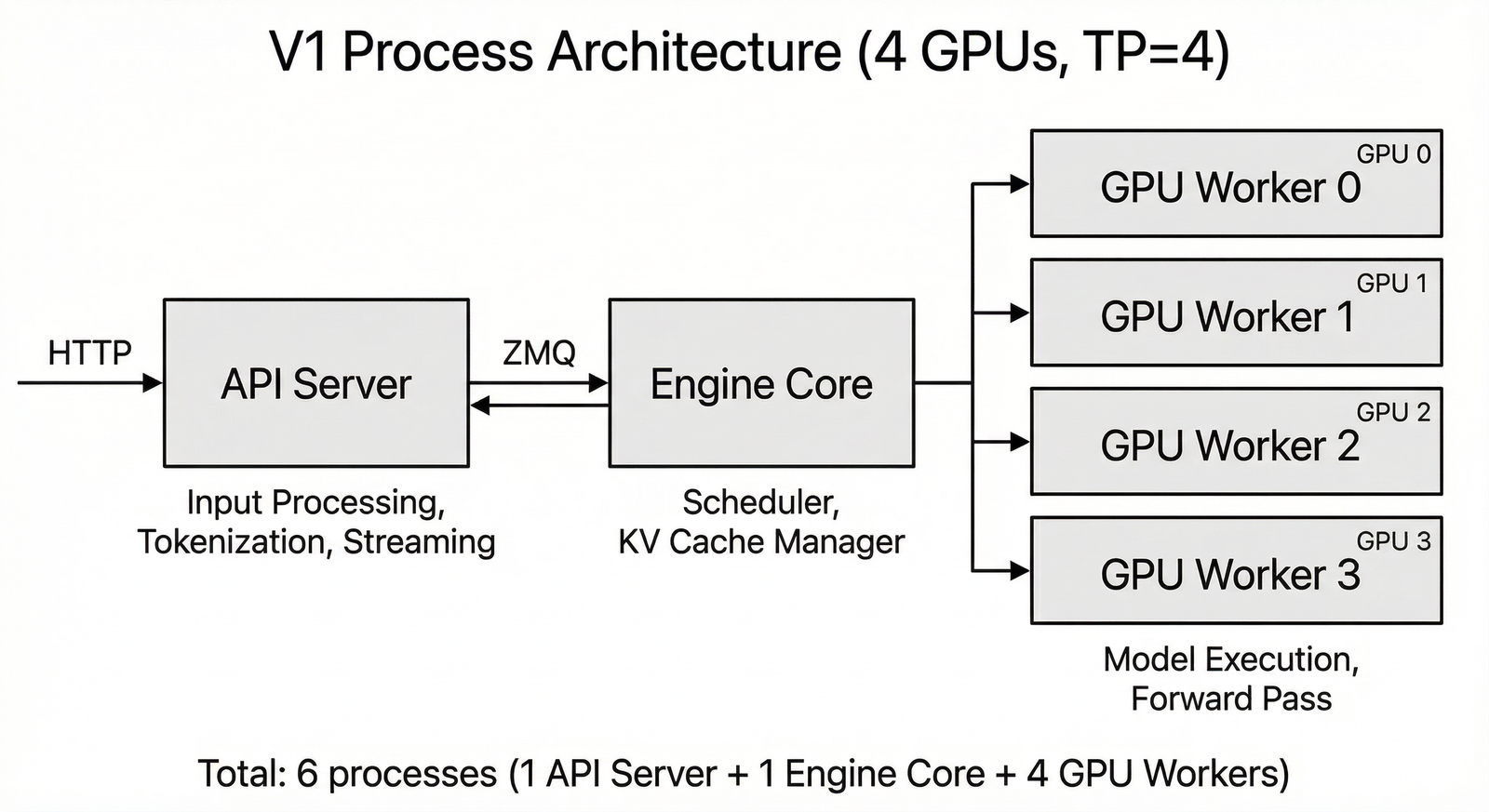
The V1 architecture separates API processing, engine-core scheduling and GPU workers. The API layer handles requests and input processing; the engine core manages scheduling and KV cache; workers execute the model. The official figure above is one tensor-parallel example, not a universal process count or minimum GPU requirement. Process architecture ↗
This separation gives a useful diagnostic order. A slow request may be waiting for admission, spending time on input processing, contending for execution capacity or blocked while results stream back. Watching GPU utilization alone cannot distinguish those cases. CPU resources and network paths belong in the review too.
Where to observe the request
Simplified reviewer interpretation; exact internals depend on version and deployment.
- 01Application request
- 02API / input processing
- 03Engine scheduling
- 04Model execution
- 05Streaming response
03 / CAPACITY
KV cache makes context a capacity decision
The scheduler and KV-cache manager are separate inspectable implementation areas. Together they help govern which work proceeds and how token-state capacity is allocated. Cache behavior, model shape and scheduling configuration should be evaluated as a system rather than as isolated tuning switches. Scheduler source ↗ KV-cache manager ↗
A request with a much longer context can occupy resources differently from many short requests. Increasing concurrency without examining the input/output-length distribution can turn a healthy average into a poor tail. Before tuning, capture the workload shape and distinguish time to first token from the pace of subsequent tokens.
Quantization and cache settings can change memory use, supported hardware and numerical behavior. Treat them as configurations to validate against representative outputs, not automatic improvements. Keep a baseline and change one variable at a time; no universal throughput multiplier is claimed here.
| Dimension | Why it matters | Record |
|---|---|---|
| Prompt length | Input work and retained token state | Distribution, not only average. |
| Output length | How long requests occupy execution | Requested and actual output lengths. |
| Arrival pattern | Queueing under bursts differs from steady load | Concurrency and arrival rate. |
| Model / precision | Capacity and quality depend on configuration | Exact model revision and runtime settings. |
| Cancellation | Abandoned work can waste capacity | Disconnect and cleanup behavior. |
04 / API CONTRACT
Compatible endpoints do not guarantee identical behavior
The documented OpenAI-compatible server supports familiar API patterns, but the documentation also describes model-dependent behavior and request differences. An existing client should be tested against the selected model, template and parser configuration. A matching URL or SDK shape is not enough to establish semantic compatibility. Serving API contract ↗
Build a contract suite around what the application actually uses: streaming termination, structured output, tool-call parsing, cancellation and error handling. Keep prompts and expected constraints small enough to inspect. A model can generate valid JSON that still fails the business rule; protocol validation and answer validation are different checks.
Separate these tests from an agent evaluation. Deep Agents coordinates tool-using work; vLLM serves inference. Connecting them adds an integration boundary—it does not remove the need to test either side.
Client contract checklist
- Check supported endpoints and parameters for the pinned version.
- Pin model revision, tokenizer/template and relevant parser settings.
- Test streaming completion, cancellation and retry behavior.
- Validate output schema separately from factual correctness.
- Record model license and distribution restrictions.
05 / OPERATIONS
Internal transport is not a public trust boundary
The security documentation explicitly requires protection for inter-node communication and describes network isolation. It also documents restricting media URL domains to reduce SSRF exposure. These are concrete deployment concerns, not reasons to assume an API-facing process can safely expose every internal port. Security guidance ↗
Place authentication, tenant quotas and application authorization at a deliberate ingress boundary. Restrict management and worker networks. Review model artifacts and any remote-code requirements before loading them. Protect prompts and generated responses in logs according to the data they contain; self-hosting alone does not establish privacy.
For upgrades, keep a known-good configuration and a rollback path. Validate startup, request compatibility and representative outputs before moving traffic. If distributing the workload across nodes, include communication failures and partial-worker loss in the plan rather than measuring only the healthy path.
| Failure | Impact | Validation / mitigation |
|---|---|---|
| Publicly reachable internal transport | Trust boundary bypass | Isolate worker networks and verify exposed ports. |
| Unbounded media fetch | Unexpected network access or resource pressure | Allowlist required domains and test rejection. |
| Capacity exhausted under bursts | Queueing and tail latency | Bound admission and test overload behavior. |
| Model/template mismatch | Incorrect output contract | Run pinned client-contract fixtures. |
| Worker or node loss | Incomplete requests and reduced capacity | Exercise recovery and rollback on a controlled deployment. |
06 / VERSION SNAPSHOT
Review the release, not just the project name
GitHub listed v0.32.0, published 18 October 2026, as the latest release at review. The inspected main manifest requires Python >=3.11 and <3.15. The release notes include Python 3.10 removal, API changes and security fixes; upgrades therefore deserve compatibility review rather than an unqualified “latest is better” recommendation. Package requirements ↗
The repository is unarchived and had active source, test and documentation work on 20 October. Apache-2.0 covers the project code; it does not replace the license of a downloaded model. Scheduler tests are available for inspection, but were not run here. Main-branch source may contain changes beyond the release. License ↗ Scheduler tests ↗
Installation depends on the accelerator and platform. Follow the official installation matrix for your exact device and runtime; do not treat a generic package-install command as a verified hardware setup. Preserve the model and deployment versions with any later measurement.
07 / VALIDATION
Measure useful service, not an isolated headline number
Start with a controlled request corpus matching the application’s prompt lengths, output lengths and modalities. Use the same model revision and comparable settings for the baseline. Warm-up, arrival pattern and concurrency must be recorded so the result can be interpreted. Report failures and cancellations alongside successful requests.
The matrix below is a proposed evaluation plan. It contains no measured scores. vLLM is worth evaluating when serving control and utilization justify platform ownership; it may be unnecessary for a low-volume application already served adequately by a managed endpoint. The decision should follow a workload result and an operating plan.
| Measure | Purpose | Boundary |
|---|---|---|
| Time to first token | Interactive responsiveness | Include queue time and report percentiles. |
| Inter-token latency | Streaming experience | Separate from first-token delay. |
| Throughput at target latency | Useful capacity | Keep workload and output quality comparable. |
| Failure / cancellation rate | Service reliability | Count unsuccessful requests too. |
| Memory and utilization | Capacity diagnosis | Record hardware and configuration. |
| Output quality | Preserve application behavior | Use task-specific checks, not speed alone. |
Evidence boundary
Reviewed
Primary source inspection
- Architecture, API documentation, manifests, scheduler and cache source.
- Dated release/activity and license evidence.
Not established
Requires an executed evaluation
- No independent benchmark or production deployment.
- No universal cost advantage or model-quality guarantee.
REFERENCE DESK
Primary sources & review boundaries
Source files and visuals are pinned to the reviewed commit. Release and activity checks are dated snapshots. Upstream images are attributed examples; diagrams in the article body are simplified interpretations. No installation, paid model calls or benchmark runs were performed for this review.
- Overview ↗ (opens in a new tab)
- Architecture ↗ (opens in a new tab)
- Serving API ↗ (opens in a new tab)
- Security ↗ (opens in a new tab)
- Scheduler ↗ (opens in a new tab)
- KV cache ↗ (opens in a new tab)
- Package requirements ↗ (opens in a new tab)
- Source tests ↗ (opens in a new tab)
- License ↗ (opens in a new tab)
- Reviewed commit ↗ (opens in a new tab)
- Release: v0.32.0 ↗ (opens in a new tab)
- Issue tracker (living source) ↗ (opens in a new tab)
Share this review
CONTINUE EXPLORING