OPEN-SOURCE REVIEW / MULTI-AGENT SIMULATION
MiroFish: simulation is not prediction
From seed documents to simulated behavior: an engineering review of graph memory, agent orchestration and the limits of generated forecasts.
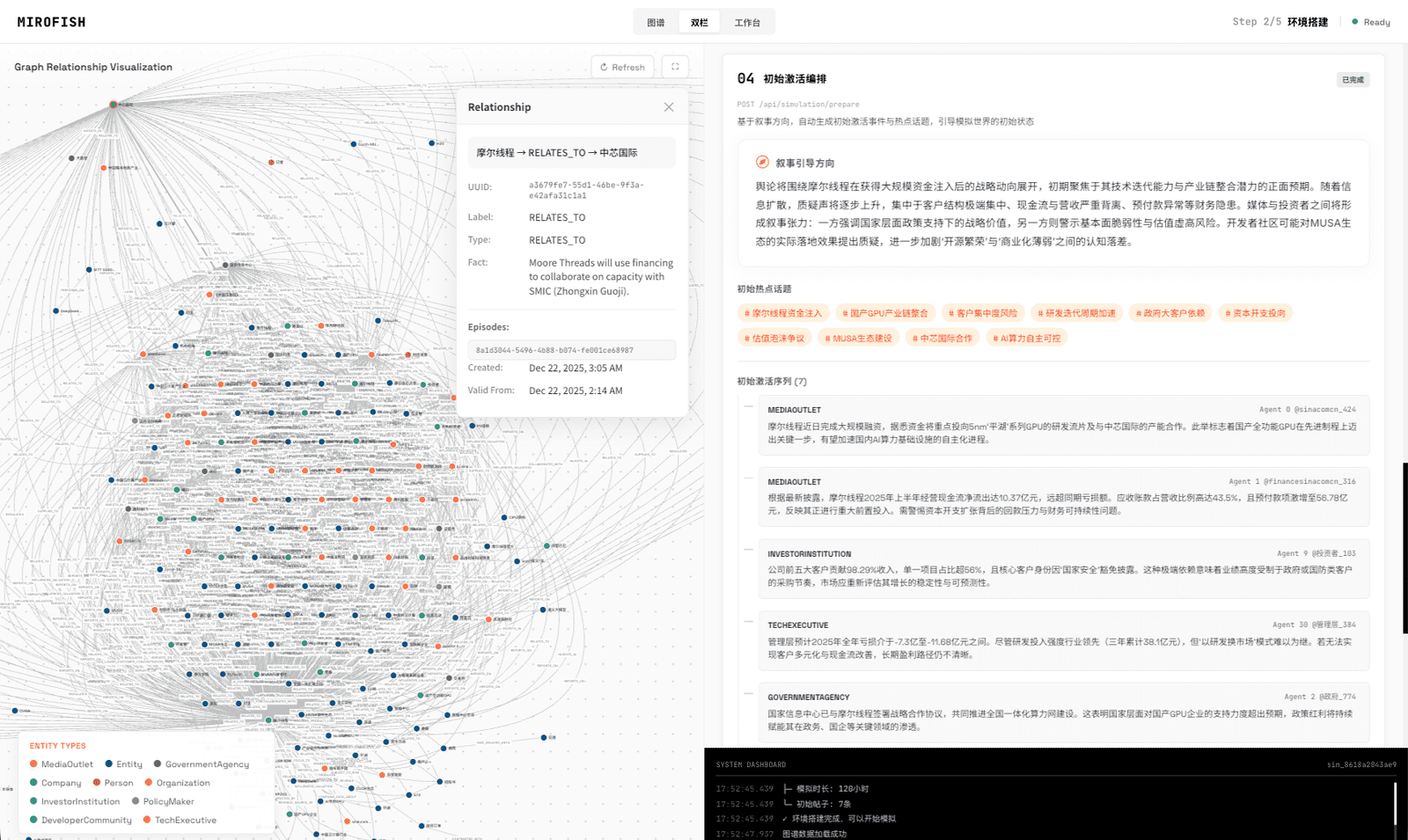 Inspect screenshot ↗
THE ENGINEERING QUESTION
How does MiroFish turn seed material into simulated interactions—and what evidence would justify trusting the resulting report?
Third-party software by the MiroFish contributors. Source snapshot: 7657031ac011 ↗.
01 / THE QUESTION
What can a simulated population actually tell us?
MiroFish turns seed material and a natural-language question into a graph-backed agent simulation and a generated report. Its maintainers position it as a broad prediction engine. That ambition is a project claim; this review evaluates the implementation as a scenario-exploration system. Project overview ↗
The useful engineering question is narrower: how do source assumptions become agent behavior, and which of those assumptions remain inspectable when a report is produced? A plausible narrative is not a calibrated forecast. Real-world predictive value would require independent observations, held-out evaluation and a baseline—not just agents that interact convincingly.
This is a third-party source review. No MiroFish installation, paid model calls, simulation run or forecast benchmark was executed for this article.
A bounded evaluation
Worth exploring
Synthetic scenario rehearsal
- Compare explicit assumptions about the same bounded situation.
- Inspect how agent configuration and memory shape a narrative.
- Study orchestration and state handling around an LLM simulation.
Not established here
Reliable prediction of external events
- No measured forecasting accuracy or calibrated probabilities.
- No demonstrated population representativeness.
- No claim of production readiness or independent performance testing.
02 / ARCHITECTURE
A graph, a simulation runtime and a report boundary
The frontend package uses Vue, Vite and D3; the backend declares Flask, an OpenAI-compatible client, Zep Cloud and CAMEL/OASIS dependencies. The graph builder splits source text and submits graph ingestion work. The simulation manager prepares profiles and configuration; the runner selects Twitter-style, Reddit-style or parallel scripts and launches a subprocess. These are simulated environments, not evidence of posting to real social networks. Frontend ↗, Backend dependencies ↗, Graph builder ↗, Simulation runner ↗.
The report agent has its own planning, tool-call and section-generation machinery. Treat it as another interpretation layer over the simulation rather than a neutral transcript. Inspecting this separation helps locate an error: was the source incomplete, the persona wrong, the run incomplete or the report unsupported? Report implementation ↗
From source material to a scenario narrative
Simplified source-inspected responsibilities; arrows summarize data dependencies rather than a measured execution trace.
Preparation
- Seed documents
- Zep graph
- Profiles + configuration
Execution
- OASIS agents
- Simulated interactions
- Activity + memory
Interpretation
- Report tools
- Generated report
- Human review
03 / STATE & MEMORY
Completion includes the memory write path
The memory updater converts agent activities into graph episodes. The runner includes a non-terminal stopping state while graph ingestion completes. This is an important architectural detail: a stopped subprocess and a fully available memory graph are different conditions. Memory updater ↗, Runner state handling ↗
One inspected test replaces the memory updater with a failure and asserts that stopping the simulation records a failed state. Other tests in the same file cover completion barriers. These are real source tests, not test results captured by this review. They show intended failure handling; they do not prove that every live Zep interaction behaves correctly. Barrier tests ↗
For an evaluator, the practical implication is to retain both the simulation status and the ingestion status. A report produced before the relevant graph writes become readable can tell a different story from the same run after reconciliation.
A completion boundary
Conceptual interpretation of the inspected runner and memory tests.
- 01Agent activity
- 02Queued graph writes
- 03Ingestion barrier
- 04Terminal state
- 05Report access
04 / RUNNING MODEL
Self-hosted application, external dependencies
The backend requires Python 3.11 or 3.12 and pins camel-oasis to 0.2.5, camel-ai to 0.2.78 and zep-cloud to 3.25.0. These are requirements in the inspected commit, not a blanket recommendation to install those versions in another application. Dependency manifest ↗
Configuration requires both LLM and Zep API credentials. It explicitly rejects a custom ZEP_API_URL: the inspected configuration supports Zep Cloud. Running the UI and API on your machine therefore does not make this an offline-only system. Review which documents and generated activities cross each provider boundary before supplying sensitive material. Configuration validation ↗
The documented workflow uses npm setup commands and uv for the backend. The Dockerfile installs locked dependencies but starts the combined development command; Compose publishes ports 3000 and 5001 and persists the uploads directory. Treat this as a starting environment, not evidence of a hardened multi-tenant deployment. Dockerfile ↗, Compose ↗, Setup instructions ↗
| Boundary | What to establish |
|---|---|
| Source checkout | Record the commit and inspect setup scripts and lockfiles before running them. |
| Frontend runtime | Resolve the Node requirement against the pinned Vite toolchain, not a generic minimum alone. |
| Provider calls | Choose an approved model endpoint and a Zep Cloud account; set a small spend budget. |
| Data | Use public or synthetic seed material; document retention and deletion expectations. |
| Execution | Start with a small agent population and round limit; record errors and costs. |
| Access | Evaluate authentication, network exposure and storage ownership before shared hosting. |
05 / EVALUATION
Make the assumptions easier to challenge
The following is a proposed evaluation protocol, not an experiment already performed. Start with a bounded fictional scenario whose input facts can be enumerated. Keep a manifest of the source documents, question, model settings, personas, graph identity and round limit. Save the generated report alongside the activity evidence it relies on.
Change one assumption at a time. Compare repeated runs against a simpler baseline such as a single model summarizing the same scenario. More agents are useful only if the additional interactions reveal something that survives inspection; consensus between agents can reflect shared model biases rather than independent evidence.
If the goal is forecasting rather than rehearsal, decide the outcome measure and evaluation window before observing the result. Keep future facts out of the seed corpus, compare against a meaningful baseline and retain failed predictions. No accuracy percentage is asserted here.
| Dimension | Evidence to retain | Failure signal |
|---|---|---|
| Input fidelity | Source facts mapped to personas and configuration | Invented or lost constraints |
| Sensitivity | Repeated runs with one controlled change | Large unexplained swings |
| Memory completeness | Ingestion status and terminal run state | Report based on missing events |
| Report traceability | Statements linked to activities or source facts | Unsupported certainty |
| Operational cost | Provider usage and time per bounded run | Uncontrolled growth in calls |
| External validity | Held-out outcomes and baseline comparison | Compelling narrative with no predictive improvement |
06 / FIT & TRADEOFFS
Useful for rehearsal; expensive as unquestioned authority
A strong fit is a developer or researcher studying how explicit personas, shared memory and interaction rules influence a synthetic scenario. A creative team can also use it to explore fictional outcomes while treating the results as generated possibilities. It is a poor fit when the requirement is a simple document answer or an externally validated forecast with no capacity to evaluate the simulation.
For document-grounded question answering, an ordinary retrieval pipeline may be a clearer baseline. For agent-runtime research, inspecting OASIS directly may isolate fewer moving parts. For a statistical forecast, compare against a domain-specific empirical model. These are alternative approaches, not a claim that one tool universally wins.
Source selection, persona design and reporting all embed assumptions. Review their combined effect before interpreting simulated public opinion as an actual population, or simulated financial behavior as actionable market evidence.
| Failure | Impact | Evaluation or mitigation |
|---|---|---|
| Biased seed material | Narrow inputs become apparent consensus | Record exclusions; compare alternative source sets |
| Homogeneous personas | Many agents repeat similar assumptions | Inspect profiles and test sensitivity to composition |
| Incomplete ingestion | Reports miss relevant interactions | Inspect barriers and test provider failure paths |
| Report overreach | Generated claims exceed simulated evidence | Trace material claims back to retained events |
| Unbounded execution | Cost and latency overwhelm the experiment | Cap population, rounds and provider spend |
07 / PROJECT EVIDENCE
Activity is not the same as maturity
On 20 October 2026, the repository was public and not archived. The inspected main-branch HEAD was 7657031ac011, committed on 1 October 2026. That commit updates star-history metadata; it should not be described as a fresh simulation feature. The latest release returned by GitHub was v0.1.2, published on 7 March 2026. Release and main-branch state are distinct snapshots. Pinned commit ↗, Release ↗
The inspected tree contains backend tests for provider contracts, profile handling, reports and ingestion barriers. Its Docker workflow configures image builds for amd64 and arm64. Source presence and workflow configuration are not proof that this reviewer ran tests, built either image or validated deployment. Example tests ↗, Build workflow ↗
Open issues and pull requests were checked as maintenance signals, not reproduced defects or shipped capabilities. My assessment is an experimental system worth studying with bounded tests, rather than a validated prediction service. The repository uses AGPL-3.0; inspect the actual license and dependency/provider terms before adopting or offering a modified service. This is not a legal assessment. Issue tracker ↗, License ↗
08 / CONCLUSION
Evaluate the system that creates the story
MiroFish is interesting because it makes the path from source material to synthetic interactions and a report available for inspection. The strongest engineering lesson is to preserve the boundaries between source evidence, configured behavior and generated interpretation.
Begin with a small question, retain the run evidence and test the assumptions. If the generated narrative remains useful after that scrutiny, expand the experiment. Do not treat an impressive simulation as a substitute for measuring what it can actually predict.
What this review establishes
Source-inspected
Pinned repository review
- Component boundaries and declared dependencies.
- Documented setup and inspected completion-barrier tests.
- Dated release, activity and license evidence.
Not independently validated
No execution or predictive benchmark
- Installation success, live service contracts and operating cost.
- Simulation scalability or production security.
- Forecast accuracy, calibration or population validity.
REFERENCE DESK
Primary sources & review boundaries
Code and documentation links are pinned to the inspected commit. Releases and issue activity were checked on 20 October 2026; living sources can change. This review contains original analysis and diagrams, an attributed maintainer screenshot. No independent execution logs or benchmark results are claimed.
- Repository (opens in a new tab)
- Pinned source commit (opens in a new tab)
- Project overview and setup (opens in a new tab)
- Backend dependencies (opens in a new tab)
- Frontend dependencies (opens in a new tab)
- Graph construction (opens in a new tab)
- Simulation preparation (opens in a new tab)
- Simulation runner (opens in a new tab)
- Graph memory updater (opens in a new tab)
- Report agent (opens in a new tab)
- Configuration and provider boundaries (opens in a new tab)
- Completion-barrier tests (opens in a new tab)
- Dockerfile (opens in a new tab)
- Compose configuration (opens in a new tab)
- Image build workflow (opens in a new tab)
- Latest listed release at review (opens in a new tab)
- Issue tracker (opens in a new tab)
- AGPL-3.0 license (opens in a new tab)
Share this review
CONTINUE EXPLORING