OPEN-SOURCE REVIEW / AGENTS / ORCHESTRATION
Deep Agents: the harness is not the boundary
Explore how Deep Agents combines planning, tools and delegation, where isolation remains your responsibility, and what to test before deploying an agent.
 Inspect screenshot ↗
THE ENGINEERING QUESTION
What does an agent harness coordinate, and which execution boundaries must the application still enforce?
Third-party open-source software. Reviewed source: 8ccbd7fdf66a ↗. License: MIT. Latest listed release: deepagents==0.7.28 (2026-10-16). Main-branch source and released packages may differ.
01 / THE QUESTION
More than a tool loop; less than an operating boundary
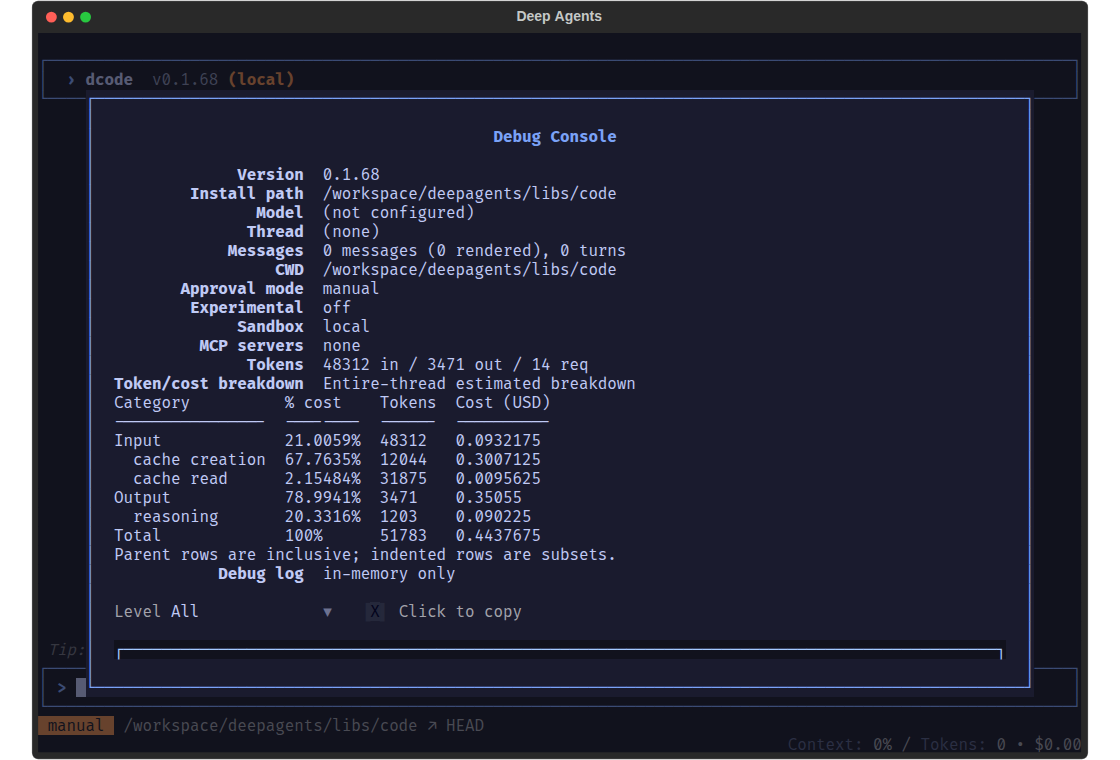
Deep Agents packages a tool-using agent with filesystem access, planning, delegation and context management. It is useful when a task needs several steps and intermediate artifacts, rather than a single model response. Its Python SDK and terminal application are different surfaces: the screenshot above shows the application, while this review focuses on the harness underneath. Project overview ↗
The engineering attraction is less assembly work. The risk is mistaking that convenience for containment. A model can choose actions; the application must decide which actions are allowed, where they execute and what counts as completion. A research assistant with read-only tools is a different deployment from an agent that can edit a repository or execute commands.
This review inspects source and documentation. No agent was installed or run, no provider credentials were used and no success-rate or cost benchmark was measured. “Production-ready” in upstream positioning is not an independent certification here.
Choose the amount of orchestration you need
Deep Agents
Opinionated harness
- Multi-step work needs files, planning and delegated context.
- You can evaluate the bundled behavior and constrain the backend.
Simpler alternatives
Direct model call, LangChain agent or explicit LangGraph workflow
- Use a direct call for a bounded transformation.
- Use an explicit workflow when steps and approval gates must be predetermined.
02 / ARCHITECTURE
Three layers, three different responsibilities
The architecture document separates LangGraph’s state and execution runtime, LangChain’s model/tool/middleware agent loop, and Deep Agents’ defaults and backend wiring. create_deep_agent assembles middleware and subagents before building the runnable agent. This is composition on top of a runtime, not a separate execution engine. Architecture ↗ Assembly source ↗
That separation helps diagnosis. A missing tool may come from the selected backend or profile. A visible but rejected operation may be a permission decision. A delegated task can have its own middleware and context. Inspect the layer that owns the behavior before adding another prompt instruction.
Control and execution are separate concerns
Reviewer’s simplified reading of the upstream architecture; not a captured run.
Harness
- Task and tool contract
- Planning / context middleware
- Model and tool loop
Execution
- Backend capability
- Permission / approval decision
- Tool result
Runtime
- LangGraph state
- Checkpoints / interrupts
- Resume or finish
Combined path
- Inspect artifacts
- Validate against task contract
03 / BOUNDARIES
A virtual filesystem is not a process sandbox
FilesystemBackend documents virtual path handling and explicitly distinguishes it from sandboxing or process isolation. Restricting file paths is useful, but it does not establish a complete boundary for arbitrary code. The factory also accepts backend and interrupt configuration; shell capability depends on the backend. Filesystem boundary ↗ Backend and interrupt configuration ↗
For a bounded evaluation, expose only the tools the task needs. Put execution in an environment with controlled credentials, network reach and writable state. Require review before external side effects. Treat retrieved documents and repository content as data, even when they contain instructions. These are deployment recommendations, not claims that the framework automatically enforces every boundary.
Permissions middleware applies policy to the built-in filesystem surface. Custom tools still need their own authorization contract. A tool named “read” can call a remote API or leak a secret if its implementation permits it; the name is not the policy. Permissions implementation ↗
| Surface | Question | Validation |
|---|---|---|
| Files | Which paths and operations are reachable? | Attempt forbidden reads and writes in a disposable fixture. |
| Commands | Where does code execute? | Verify process, credential and network containment. |
| Custom tools | Who authorizes the side effect? | Test rejected scope and duplicate invocations. |
| Delegation | What context and tools cross the boundary? | Trace a subtask and inspect its effective permissions. |
04 / STATE & CONTEXT
Checkpointed does not mean semantically correct
The runtime preserves graph state and checkpoints; backend choices govern files and memory. The architecture describes the default state backend as thread-scoped, with other backends enabling different persistence behavior. Do not infer cross-session memory from a file-shaped tool interface. State and persistence ↗
Context compression and delegated work can reduce the amount of material a single model call sees, but they can also lose a qualification or duplicate work. Persist source references with intermediate artifacts. If a run resumes after a tool has already changed an external system, idempotency matters more than whether the conversation looks continuous.
Define completion using observable artifacts: a patch that passes the relevant checks, a report whose claims map to sources, or a structured answer satisfying a schema. A confident final message is not the acceptance test.
A safer completion contract
Suggested evaluation flow, not a built-in guarantee.
- 01Bounded task
- 02Scoped tools
- 03Artifact plus provenance
- 04Independent validation
- 05Human release decision
05 / SETUP & MAINTENANCE
Pin the SDK; inspect the example’s dependencies
The inspected Python package declares Python >=3.11 and <4.0, and SDK version 0.7.28. The latest release returned by GitHub was deepagents==0.7.28 on 16 October 2026. Its release note fixes ContextHubBackend.glob path handling. The reviewed main commit is newer than that release; do not assume every main-branch detail is in the released wheel. Package manifest ↗
The deep-research example has its own setup and provider/search credentials. Installing an open-source harness does not make hosted model calls free or local. Start with the official example that matches your task, pin its dependencies and inspect the tools before supplying credentials. Research example setup ↗
The repository is unarchived and had substantive SDK changes on the review date, including rejection of text edits on binary files. It uses MIT terms. Source tests exist, but this review did not execute them or verify the CI status; activity is a maintenance signal, not proof of reliability. License ↗ Graph tests ↗
Before the first controlled run
- Record SDK, provider model and backend versions.
- Use a disposable workspace and minimal credentials.
- Define tool permissions and approval requirements.
- Set an application budget and stopping condition.
- Keep trace/artifact evidence and record what actually ran.
06 / EVALUATION
Test the failure path before trusting the long task
Use a small set of tasks with known acceptance conditions. Compare the same model and tool surface with a simpler baseline. Repeat runs because a single successful trajectory does not establish reliability. Record tool attempts, approvals, artifacts, retries and total usage—not only the final answer.
The following is a proposed protocol, not an executed experiment. Include malicious instructions in retrieved content, missing dependencies, denied file access, tool timeouts and an interrupted run. A useful harness should make those outcomes inspectable; your application decides whether to retry, stop or ask a person.
| Failure | Signal to capture | Acceptance boundary |
|---|---|---|
| Untrusted content redirects the task | Attempted tools and affected paths | No unauthorized side effect. |
| Subagent drops a constraint | Delegated input and returned artifact | Original requirements remain checkable. |
| Tool repeats after resume | External operation IDs | No duplicate mutation. |
| Run expands without useful progress | Usage and artifact changes | Budget or stopping rule ends the run. |
| Plausible but unsupported report | Claim-to-source mapping | Unsupported claims are rejected. |
07 / DECISION
Adopt the defaults only after testing their boundaries
Deep Agents is worth evaluating when planning, file-backed work and delegation are recurring engineering needs. It is less compelling for a small deterministic integration that already has clear steps and a narrow tool surface. The decision is about reduced orchestration work versus additional behavior to inspect.
This review supports an architecture-level understanding of the harness. It does not establish production security, autonomous delivery quality or cost savings. The next credible step is a bounded fixture with real artifacts, explicit failure cases and a simpler baseline—not a larger unsupervised assignment.
REFERENCE DESK
Primary sources & review boundaries
Source files and visuals are pinned to the reviewed commit. Release and activity checks are dated snapshots. Upstream images are attributed examples; diagrams in the article body are simplified interpretations. No installation, paid model calls or benchmark runs were performed for this review.
- Overview ↗ (opens in a new tab)
- Architecture ↗ (opens in a new tab)
- Agent construction ↗ (opens in a new tab)
- Filesystem backend ↗ (opens in a new tab)
- Permissions ↗ (opens in a new tab)
- Package versions ↗ (opens in a new tab)
- Source tests ↗ (opens in a new tab)
- Research example ↗ (opens in a new tab)
- License ↗ (opens in a new tab)
- Reviewed commit ↗ (opens in a new tab)
- Release: deepagents==0.7.28 ↗ (opens in a new tab)
- Issue tracker (living source) ↗ (opens in a new tab)
Share this review
CONTINUE EXPLORING