EXPERTISE / 06
Agentic AI & AI-Assisted Authoring
I explore how AI-assisted content variations, assembly and metadata proposals can become controlled authoring workflows. The engineering question is not just whether a model can produce content, but which changes it may propose, who approves them and how the system applies them safely.
Architecture exploration / local PoC. No claim of production Adobe agent deployment. Adobe sources reviewed 21 October 2026; the downloadable example runs without AEM, Coworker or a model provider.
 Inspect screenshot ↗
ASSESSMENT FLOW
- Brief
- Content snapshot
- Proposed change
- Policy validation
- Human approval
- Draft update
PRODUCT BOUNDARIES
Agentic capability is not unrestricted autonomy
Adobe announced general availability of CX Enterprise Coworker on 10 June 2026. That announcement does not establish that every AEM agent capability became generally available in the October 2026 release. I could not verify that specific October assertion and do not use it as a release claim here.
Adobe’s agentic overview describes agent capabilities across applications, including content discovery and visual variants in Content Advisor, and experience production in Brand Experience Agent. Access depends on licensing or trial arrangements and underlying application permissions. Confirm the exact capability and tenant entitlement before designing an integration.
Agentic Marketing Garage is Adobe’s hands-on user-group event series. It is a learning format, not an AEM runtime component or evidence that teams can bypass approval. Adobe’s Coworker announcement describes teams approving plans and launching campaigns. This page treats review as an explicit design boundary.
- Sources: Adobe GA announcement, agentic overview and Marketing Garage page, linked in Official references below.
- No undocumented Coworker endpoint, permission claim or autonomous publishing capability is assumed.
WHERE THIS FITS
Three useful proposal types, one controlled write boundary
Content variations can propose a locale-specific title or channel adaptation against an approved source. The variation must preserve required facts, legal copy and references. Fluent text alone does not prove compliance; structural validation and editorial review solve different problems.
Personalized assembly can propose a combination of approved fragments for a declared context. Keep audience eligibility, identity and consent decisions outside the generative prompt. A suggested assembly should not silently enroll a customer in a segment or publish a personalized experience.
Metadata assistance can propose tags from a managed vocabulary. Reject unknown tags and treat inferred sensitive classifications as a separate governance decision. This example intentionally allows only three synthetic outdoor-interest tags; it does not demonstrate enterprise asset tagging at scale.
Proposal plane and write plane
Proposed architecture, not a captured Adobe topology. The local example implements only the approval gate and an in-memory draft.
Proposal
- Brief and approved source
- Model adapter
- Typed proposal
- Policy validation
Authority
- Authenticated reviewer
- Exact proposal approval
- Scoped write adapter
- Versioned draft
Combined path
- Separate publication workflow
- Audit and reconciliation
EXAMPLE 01
Validate the proposal before it reaches a writer
The source of a proposal is deliberately replaceable. It could be an author, a deterministic fixture or a model adapter. It never supplies its own permissions. Unknown fields, actions outside draft editing, unsupported locales and unknown taxonomy values are rejected before approval.
The following is our application contract, not Adobe JSON or a model-provider response. Titles are plain text. A real renderer must escape them; a real policy must also handle brand claims, rights, localization and private information. Schema validation cannot establish factual accuracy.
FILE · fixture.mjs — synthetic inputs and trusted-caller fixtures
javascriptexport const source = { id: 'fragment-spring', version: 7, title: 'Explore outdoors', tags: ['outdoors'], locale: 'en' };
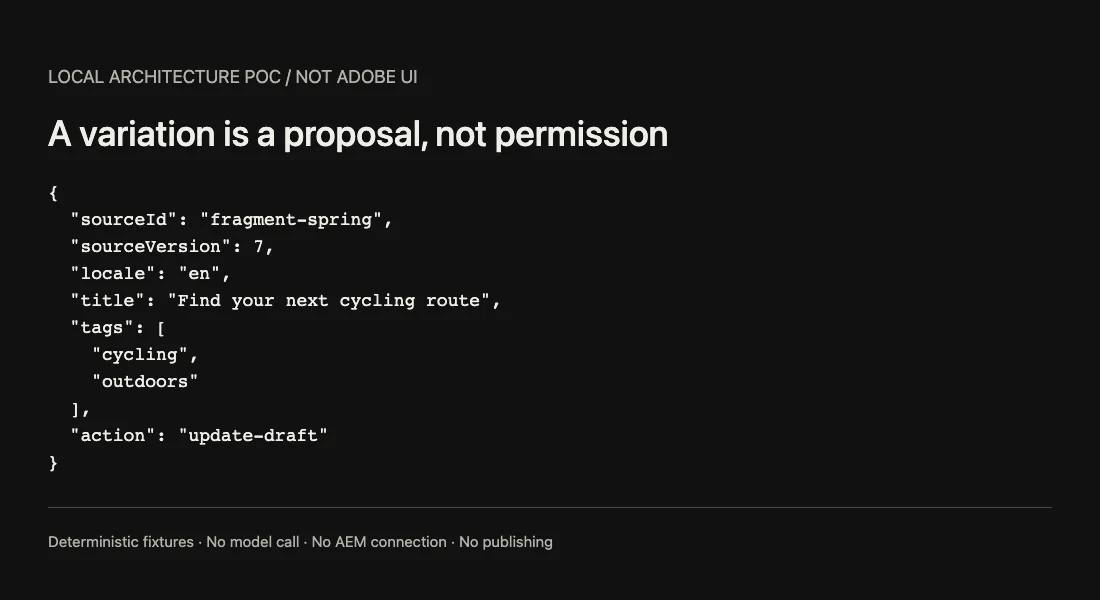
export const proposal = { sourceId: source.id, sourceVersion: 7, locale: 'en', title: 'Find your next cycling route', tags: ['cycling', 'outdoors'], action: 'update-draft' };
export const reviewer = { id: 'fixture-reviewer', permissions: ['approve'], sources: [source.id] };
export const worker = { id: 'fixture-worker', permissions: ['write-draft'], sources: [source.id] };
FILE · policy.mjs — strict proposal validation
javascriptimport { createHash } from 'node:crypto';
// Local application contract, NOT an Adobe API or authentication mechanism.
export function validateProposal(p) {
if (!p || typeof p !== 'object' || Array.isArray(p)) throw Error('Invalid proposal');
const keys = ['sourceId', 'sourceVersion', 'locale', 'title', 'tags', 'action'];
if (Object.keys(p).some(k => !keys.includes(k))) throw Error('Unknown field');
if (!/^fragment-[a-z0-9-]+$/.test(p.sourceId ?? '')) throw Error('Invalid source');
if (!Number.isInteger(p.sourceVersion) || p.sourceVersion < 1) throw Error('Invalid version');
if (!['en', 'fr'].includes(p.locale)) throw Error('Unsupported locale');
if (typeof p.title !== 'string' || !p.title.trim() || p.title.length > 80) throw Error('Invalid title');
if (p.action !== 'update-draft') throw Error('Only draft updates allowed');
if (!Array.isArray(p.tags) || p.tags.length > 3 || p.tags.some(t => !['cycling', 'running', 'outdoors'].includes(t))) throw Error('Invalid taxonomy');
return structuredClone(p);
}
 Inspect screenshot ↗
EXAMPLE 02
Approve the exact change, not an open-ended agent
Approval is bound to a digest of the validated proposal, including source revision. Changing the title after review changes that digest. The writer also checks the current revision so an approval for an old snapshot cannot overwrite newer work.
The actor objects below are trusted fixtures. In a real service, derive identity and scope from authenticated server-side context, not JSON sent by a browser or model. A digest identifies content; it is not authentication or a digital signature.
This synchronous in-memory gate demonstrates ordering, not distributed correctness. Production approval storage, revision checks, writes and idempotency need a durable design. A crash between a remote write and recording its result requires reconciliation; simply copying this Map implementation into a service would not solve that problem.
FILE · policy.mjs — exact-payload approval and draft-only apply
javascriptexport function digest(proposal) {
const p = validateProposal(proposal);
// Explicit ordering avoids treating property insertion order as a change.
return createHash('sha256').update(JSON.stringify([
p.sourceId, p.sourceVersion, p.locale, p.title, [...p.tags].sort(), p.action,
])).digest('hex');
}
export function createDraftGate(initial) {
let draft = structuredClone(initial);
const approvals = new Map();
const applied = new Set();
function authorize(actor, permission) {
// actor is supplied by a trusted caller in a real adapter, NEVER model output.
if (!actor?.permissions?.includes(permission) || !actor.sources?.includes(draft.id)) throw Error('Not authorized');
}
return {
read: () => structuredClone(draft),
approve(proposal, reviewer) {
authorize(reviewer, 'approve');
const p = validateProposal(proposal);
if (p.sourceId !== draft.id || p.sourceVersion !== draft.version) throw Error('Stale source');
const key = digest(p);
approvals.set(key, reviewer.id);
return key;
},
apply(proposal, worker) {
authorize(worker, 'write-draft');
const p = validateProposal(proposal);
const key = digest(p);
if (applied.has(key)) return { status: 'duplicate', version: draft.version };
if (p.sourceId !== draft.id || p.sourceVersion !== draft.version) throw Error('Stale source');
if (!approvals.has(key)) throw Error('Approval required');
draft = { ...draft, title: p.title, tags: p.tags, locale: p.locale, version: draft.version + 1 };
applied.add(key);
return { status: 'draft-updated', version: draft.version, approvedBy: approvals.get(key) };
},
};
}
AEM ADAPTER
Keep the application contract separate from Adobe APIs
Adobe documents separate Content Fragment management and delivery APIs. An authoring integration belongs on the supported, authenticated management surface; a read-oriented delivery endpoint is not an editing contract. Confirm tenant configuration and the current API definition before implementing the adapter.
Map a stable source identifier to a server-controlled fragment, fetch its current state and resolve authorization before writing. Keep tokens out of prompts, proposals and browser code. Do not give the model an arbitrary HTTP tool with an unrestricted URL, method and body.
The fixture has no HTTP adapter, Adobe SDK or inferred endpoint. The proposed adapter contract below is intentionally pseudocode: read a versioned snapshot; verify approved proposal and scope; apply a conditional draft change using the actual supported API; record outcome; reconcile uncertain responses. Where the API lacks the required concurrency primitive, design serialization or conflict handling explicitly rather than pretending sourceVersion is a vendor field.
Proposed integration sequence
Not executed against Adobe. Publication remains separate from a draft update.
- 01Authenticate caller
- 02Resolve permitted fragment
- 03Read current state
- 04Verify approval and revision
- 05Apply supported draft operation
- 06Record or reconcile result
RUN THE EXAMPLE
Eight local policy tests, with captured output
Download the source ZIP using the link beneath the introduction, extract it and run the commands in its directory. Node.js 22 or newer is required; no npm install, credentials or external service is needed. The test capture was produced with Node v22.22.3 on 21 October 2026.
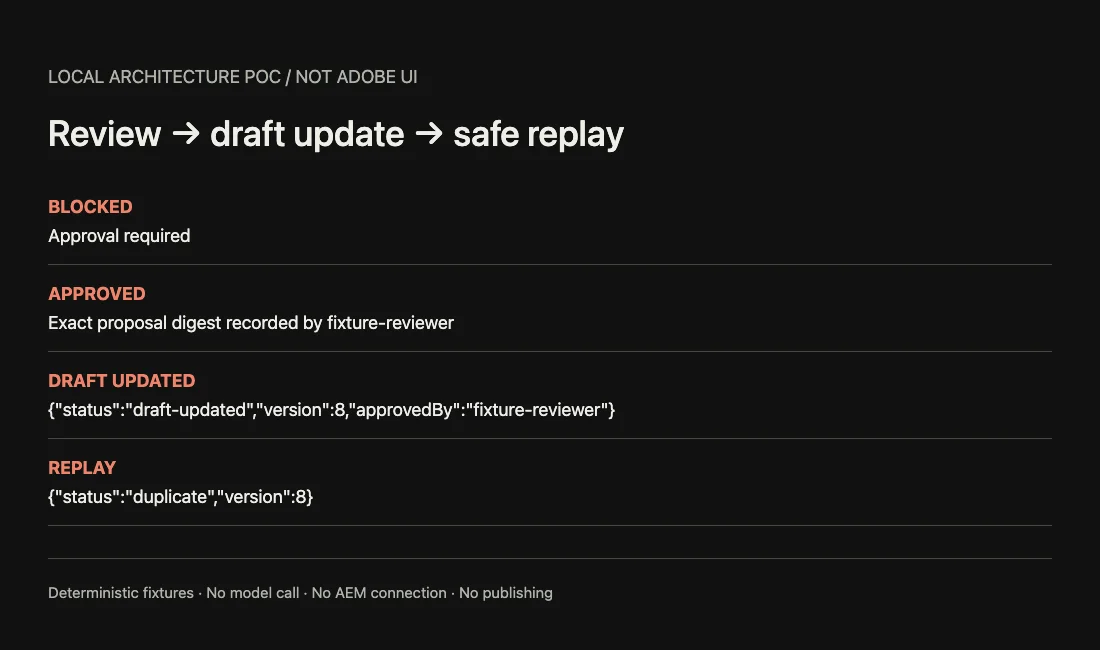
node report.mjs executes the gate against synthetic fixtures and writes report.html. Open that local file to inspect the two report panels shown in the screenshots. This is a policy experiment around an authoring workflow; it does not generate text or execute an autonomous agent.
RUN · extracted example directory
shellnode --test policy.test.mjs
node report.mjsFILE · policy.test.mjs — positive and negative contracts
javascriptimport { test } from 'node:test';
import assert from 'node:assert/strict';
import { createDraftGate, validateProposal } from './policy.mjs';
import { source, proposal, reviewer, worker } from './fixture.mjs';
test('approved proposal updates a draft only', () => {
const gate = createDraftGate(source);
gate.approve(proposal, reviewer);
assert.equal(gate.apply(proposal, worker).status, 'draft-updated');
assert.equal(gate.read().version, 8);
assert.equal(gate.read().title, proposal.title);
});
test('unapproved proposal is rejected without changing content', () => {
const gate = createDraftGate(source);
assert.throws(() => gate.apply(proposal, worker), /Approval required/);
assert.deepEqual(gate.read(), source);
});
test('approval cannot authorize changed content', () => {
const gate = createDraftGate(source); gate.approve(proposal, reviewer);
assert.throws(() => gate.apply({ ...proposal, title: 'Changed after review' }, worker), /Approval required/);
});
test('stale source revision is rejected', () => {
const gate = createDraftGate({ ...source, version: 8 });
assert.throws(() => gate.approve(proposal, reviewer), /Stale source/);
});
test('publish action is outside the contract', () => {
assert.throws(() => validateProposal({ ...proposal, action: 'publish' }), /draft updates/);
});
test('unknown tags and fields are rejected', () => {
assert.throws(() => validateProposal({ ...proposal, tags: ['sensitive-segment'] }), /taxonomy/);
assert.throws(() => validateProposal({ ...proposal, token: 'untrusted' }), /Unknown field/);
});
test('unauthorized actor cannot approve or write', () => {
const gate = createDraftGate(source);
assert.throws(() => gate.approve(proposal, worker), /Not authorized/);
gate.approve(proposal, reviewer);
assert.throws(() => gate.apply(proposal, { ...worker, sources: [] }), /Not authorized/);
});
test('replaying an applied proposal does not write twice', () => {
const gate = createDraftGate(source); gate.approve(proposal, reviewer);
gate.apply(proposal, worker);
assert.equal(gate.apply(proposal, worker).status, 'duplicate');
assert.equal(gate.read().version, 8);
});
CAPTURED OUTPUT · Node v22.22.3 · 21 October 2026
textTAP version 13
# Subtest: approved proposal updates a draft only
ok 1 - approved proposal updates a draft only
---
duration_ms: 7.289166
type: 'test'
...
# Subtest: unapproved proposal is rejected without changing content
ok 2 - unapproved proposal is rejected without changing content
---
duration_ms: 0.993458
type: 'test'
...
# Subtest: approval cannot authorize changed content
ok 3 - approval cannot authorize changed content
---
duration_ms: 0.241334
type: 'test'
...
# Subtest: stale source revision is rejected
ok 4 - stale source revision is rejected
---
duration_ms: 0.094625
type: 'test'
...
# Subtest: publish action is outside the contract
ok 5 - publish action is outside the contract
---
duration_ms: 0.099291
type: 'test'
...
# Subtest: unknown tags and fields are rejected
ok 6 - unknown tags and fields are rejected
---
duration_ms: 0.082542
type: 'test'
...
# Subtest: unauthorized actor cannot approve or write
ok 7 - unauthorized actor cannot approve or write
---
duration_ms: 0.092667
type: 'test'
...
# Subtest: replaying an applied proposal does not write twice
ok 8 - replaying an applied proposal does not write twice
---
duration_ms: 0.217042
type: 'test'
...
1..8
# tests 8
# suites 0
# pass 8
# fail 0
# cancelled 0
# skipped 0
# todo 0
# duration_ms 71.406708
CAPTURED RUN · report.mjs
json{
"node": "v22.22.3",
"events": [
[
"BLOCKED",
"Approval required"
],
[
"APPROVED",
"Exact proposal digest recorded by fixture-reviewer"
],
[
"DRAFT UPDATED",
"{\"status\":\"draft-updated\",\"version\":8,\"approvedBy\":\"fixture-reviewer\"}"
],
[
"REPLAY",
"{\"status\":\"duplicate\",\"version\":8}"
]
]
}
FAILURE MODES
An approval workflow still needs operational controls
These are proposed production checks. Only the local contracts listed in the next section were executed. Model output quality, real permissions and recovery must be evaluated in their own environments.
| Risk | Detection | Mitigation |
|---|---|---|
| Prompt injection in source content | Adversarial input tests and tool audit | Treat content as data; constrain tools; authenticate outside the prompt |
| Content changes after review | Digest mismatch | Require a new approval for the changed proposal |
| Newer source overwritten | Revision conflict | Reject stale changes; rebase and review again |
| Repeated write after timeout | Duplicate request / uncertain outcome | Durable idempotency plus remote-state reconciliation |
| Incorrect or sensitive tags | Vocabulary and policy checks; human review | Managed taxonomy; separate sensitive classifications |
| Unbounded spend or bulk damage | Budget and batch limits | Bound retries, execution time and affected assets; staged rollout |
VALIDATION BOUNDARY
What the PoC proves—and what remains to validate
The local result supports a narrow claim: the fixture rejects certain invalid or unauthorized proposals, binds approval to a specific change and avoids an immediate duplicate write within one process. It does not establish production AI expertise or Adobe integration compatibility.
Evidence boundary
Validated locally
8 deterministic Node tests
- Draft-only action, allowed fields and taxonomy
- Missing approval and changed payload rejection
- Stale source rejection and source-scoped fixture permissions
- One-process replay detection
Not validated
Requires separate integration and operational work
- Coworker APIs, AEM tenant permissions and Adobe licensing
- Real LLM generation, factual accuracy and brand compliance
- Consent, personalization and content rights enforcement
- Persistent transactions, concurrency, recovery and scale
- Source and recorded output are included in the download linked beneath the introduction.
- Candidate next experiment: a development-only AEM adapter with two conflicting edits, denied permission, timeout and retry cases; no autonomous production publishing.
ENGINEERING NOTES